
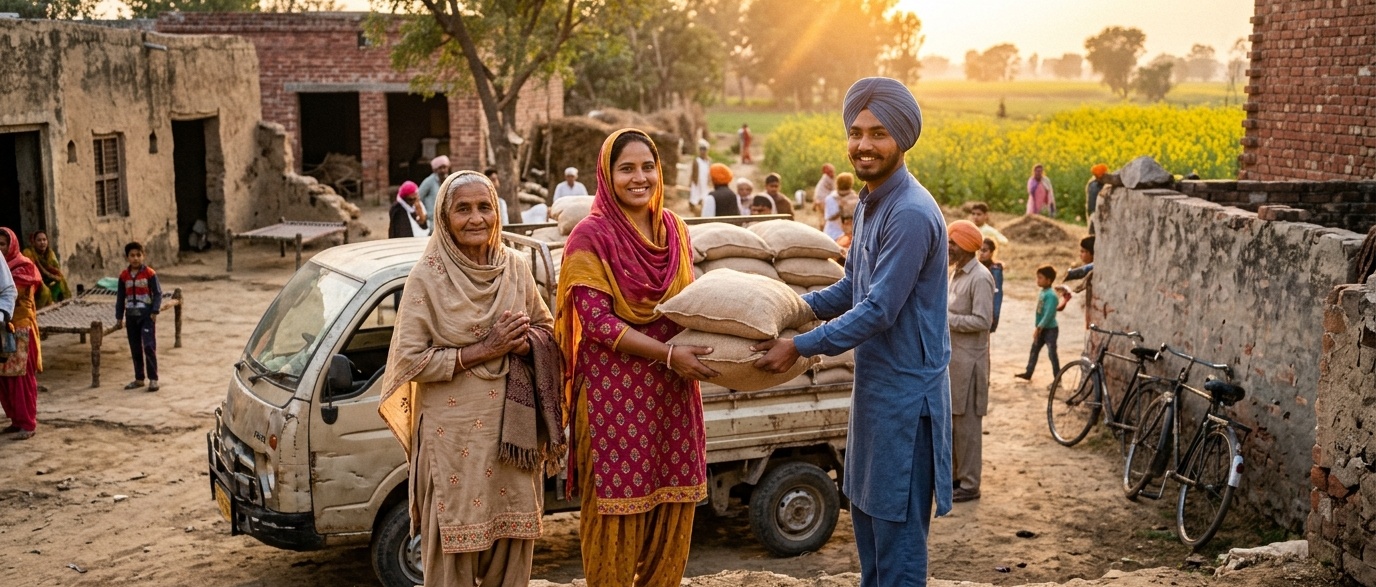
The Department of Food, Civil Supplies and Consumer Affairs, Government of Punjab, oversees the modernized Punjab Smart Ration Card Atta-Dal Scheme (ਆਟਾ-ਦਾਲ ਸਕੀਮ / ਘਰ-ਘਰ ਰਾਸ਼ਨ ਯੋਜਨਾ) to guarantee complete nutritional security for underprivileged and low-income families. Re-engineered under the historic Ghar Ghar Ration initiative, the state has eliminated long queues at fair price shops by delivering hygienically packaged, high-grade wheat flour (atta) and staple pulses (dal) directly to beneficiaries' doorsteps.
Utilizing micro-chipped Digital Smart Ration Cards and biometrically enabled POS delivery vans, this welfare framework prevents grain diversion, eliminates black-marketing, and guarantees that food assistance reaches the most vulnerable households across Punjab.
Punjab Atta-Dal Scheme: Key Highlights
| Particulars | Official Scheme Details |
|---|---|
| Scheme Name | Punjab Smart Ration Card Atta-Dal Scheme (Ghar Ghar Ration Delivery) |
| Nodal Department | Department of Food, Civil Supplies & Consumer Affairs, Punjab |
| Target Beneficiaries | Antyodaya Anna Yojana (AAY) and Priority Household (PHH) cardholders |
| Food Grains Provided | Packaged Wheat Flour (Atta) and Subsidized Pulses (Dal) |
| Distribution Mode | Doorstep delivery via GPS-tracked mobile vans & biometric Fair Price Shops |
| Identification Card | Biometric NFC-enabled Digital Smart Ration Card |
| Official Portal | epos.punjab.gov.in / foodsupppb.gov.in |
Core Objectives & Key Benefits
The reformed Atta-Dal scheme delivers systemic improvements over legacy public distribution practices:
- Doorstep Delivery Convenience: Pre-cleaned, packaged wheat flour is delivered directly to rural and urban homes, saving elderly and daily-wage citizens from losing work hours in grain queues.
- Quality Assurance: Grains are cleaned, processed into certified flour in inspected milling units, and packed in moisture-resistant tamper-evident bags.
- Zero Leakage Biometric PDS: Distribution utilizes electronic Point of Sale (e-PoS) machines equipped with Aadhaar iris and fingerprint scanners, guaranteeing zero fake ghost beneficiaries.
- Nutritional Balance: Beyond carbohydrates from wheat, subsidized pulse distribution addresses protein deficiencies among growing children and nursing women.
Eligibility Criteria
To qualify for enrolment under the Punjab Smart Ration Card scheme, families must meet these socio-economic conditions:
- Punjab Domicile: The applicant and family members must be verified permanent residents of Punjab.
- Household Income Cap: Annual family income from all combined sources must not exceed ₹60,000 per annum (or meet designated BPL/AAY thresholds).
- Landholding Limits: In rural areas, the family must not own more than 2.5 acres of wetland or 5 acres of barani (unirrigated) farmland.
- Residential Property Norms: In urban municipal jurisdictions, residential property area must not exceed 100 sq. yards.
- Asset Restrictions: The household must not own a four-wheeled commercial or passenger motor vehicle.
- Exclusions: Regular government employees, income tax payees, and commercial business license holders are strictly ineligible.
Required Documents
Assemble these verified photocopies for new Smart Ration Card application or e-KYC validation:
- Aadhaar Cards: Mandatory Aadhaar cards for every family member listed in the ration unit.
- Proof of Address: Punjab Domicile Certificate, Electricity Bill, or Voter ID card.
- Income Certificate: Verified family income certificate issued by the Tehsildar or SDM office.
- Bank Account Details: Bank passbook copy of the female head of the family (seeded with Aadhaar).
- Family Photograph: Joint passport-sized photograph of all family members.
- Mobile Number: Active mobile number for receiving OTP and grain delivery intimation SMS alerts.
Registration & Enrolment Procedure
Step 1: Verification at Local Sewa Kendra
Obtain the NFSA / Smart Ration Card application form from your nearest village Sewa Kendra or download it from the official food supplies portal.
Step 2: Gram Panchayat / Municipal Scrutiny
Get your family details verified and attested by your local village Sarpanch, Panchayat Secretary, or Municipal Councillor.
Step 3: Biometric Data Capture
Submit documents at the Sewa Kendra where fingerprints and facial iris profiles of all adult members are recorded on the ePDS server.
Step 4: Smart Card Issuance & Doorstep Linking
Upon Food and Civil Supplies Inspector approval, your digital Smart Ration Card is generated and mapped to your zonal distribution vehicle.
Verified Official Portals & Direct Links
Check your name in the state beneficiary list or track ration allotment records via authorized government portals:
To leave a comment, click the button below to sign in with Blogger.