
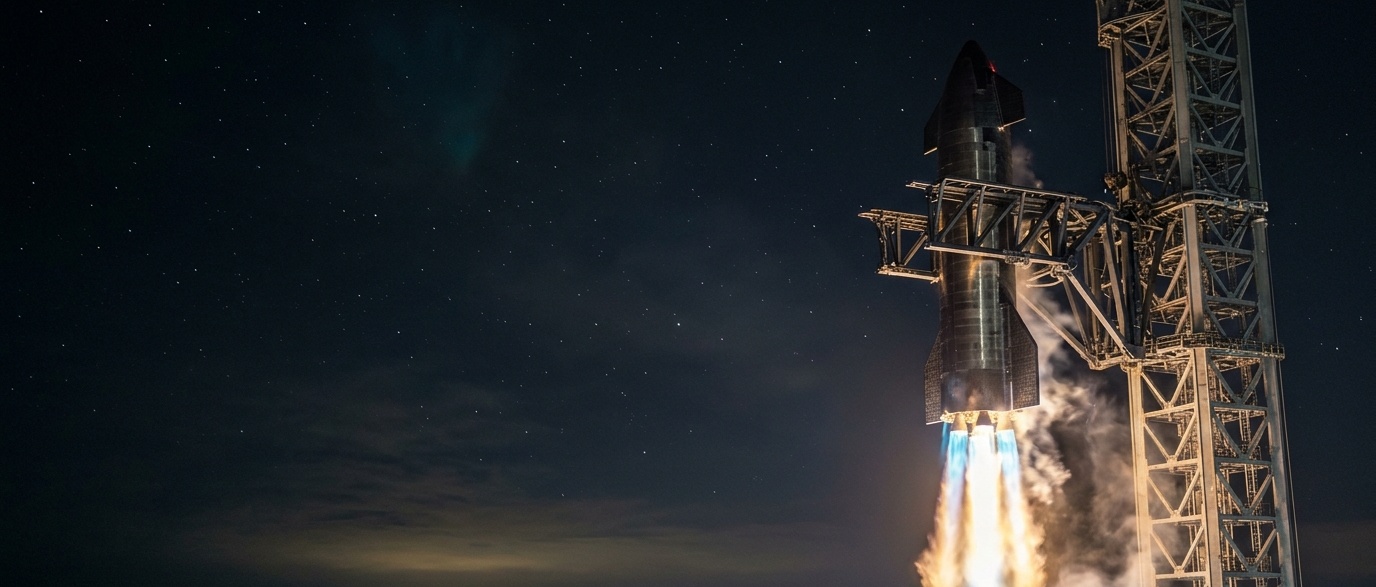
In an unprecedented breakthrough that redefines the future of space exploration, SpaceX has successfully executed the world's first-ever mid-air "catch" of an orbital-class Starship spacecraft using the giant mechanical "chopstick" arms of the Mechazilla launch tower at Starbase, Texas. Returning from a grueling 22.5-hour orbital mission during Integrated Flight Test 15 (IFT-15), the 50-meter stainless steel ship endured atmospheric re-entry heat exceeding 1,400°C before executing its signature belly-flop-to-vertical flip and being smoothly snared out of the sky.
While aerospace engineers previously witnessed the capture of Super Heavy boosters, catching a returning orbital spacecraft is universally recognized by astrophysicists as the "Holy Grail of rocketry". This monumental triumph confirms the feasibility of 100% rapid reusability—slashing the cost of putting mass into orbit by more than 95% and locking in the logistical timeline for NASA's Artemis lunar landings and human missions to Mars.
SpaceX Starship Flight 15 (IFT-15) Technical Mission Overview
| Mission Metric | Official Flight 15 Specification |
|---|---|
| Launch Vehicle Configuration | Starship Upper Stage (Ship 36) + Super Heavy Booster (Booster 15) |
| Launch Site Location | Starbase Orbital Launch Pad A, Boca Chica, Texas |
| Orbital Duration | 22.5 Hours (14 Full Earth Orbits Completed) |
| Primary Milestone Achieved | First Orbital Ship Tower Catch via Mechazilla Chopsticks |
| Payload Deployment | 26 Next-Generation Direct-to-Cell Starlink V3 Satellites |
| Super Heavy Booster Outcome | Diverted Offshore; Controlled Soft Water Landing in Gulf of Mexico |
| Propulsion Architecture | 33 Raptor 3 Engines (Booster) + 6 Raptor Engines (Ship) |
Why Catching an Orbital Spacecraft Was Considered "Impossible"
To grasp the magnitude of SpaceX’s achievement, one must understand the extreme physics of orbital mechanics. While a booster only ascends to the edge of space before separating at Mach 6, the Starship upper stage accelerates to full orbital velocity—traveling at over 28,000 km/h (Mach 25).
Returning from low Earth orbit requires shedding immense kinetic energy purely through atmospheric friction. As temperatures enveloped the vehicle in blinding plasma, the upgraded hexagonal ceramic heatshield tiles protected the critical stainless steel skin. Unlike capsules that deploy parachutes or space planes that need massive runways, Starship plummeted belly-first like a skydiver, lit three central Raptor engines seconds above the ground, flipped upright with precision vectoring, and gently drifted between the steel arms of the launch tower.
"Catching a 100-ton rocket stage traveling at orbital speeds with mechanical arms is comparable to catching a falling skyscraper with giant tweezers. Today, spaceflight entered the era of true airplane-like operations."
Mechazilla in Action: Millimeter Precision at Subsonic Deceleration
The Starbase launch tower—towering 146 meters high—utilizes massive hydraulic cables, shock-absorbing carriage rails, and high-speed laser telemetry sensors to track the descending vehicle. As Ship 36 hovered on a column of fire, its reinforced structural hardpoints slid directly into the cushioned guides of the chopstick arms. Within 0.8 seconds of contact, the arms clamped shut and took the full weight of the vehicle as the engines shut down, greeted by euphoric cheers from thousands of spectators lining South Padre Island.
Booster 15: Safe Offshore Diversion
SpaceX initially engineered Flight 15 for a "double catch"—attempting to catch both the booster and the ship in a single day. However, automated telemetry detected a slight fuel mass discrepancy during the boostback burn. In accordance with safety algorithms, the booster aborted tower approach and executed a controlled landing burn over open water before splashdown in the Gulf of Mexico, ensuring zero danger to the primary launch infrastructure.
Economic Disruption: Reducing Launch Costs to Under $50 Per Kilogram
Traditional multi-stage orbital rockets (such as NASA's SLS or Europe's Ariane 6) discard hundreds of millions of dollars worth of engines and fuel tanks into the ocean after every flight. By eliminating landing legs entirely—which saves substantial dead-weight—and catching both the booster and the upper stage at the launch site, SpaceX can theoretically inspect, refuel, and relaunch a Starship within hours rather than months.
Industry analysts project that full reusability will bring the cost of launching cargo to space down from $2,500/kg (Falcon 9) to less than $50 per kilogram, unlocking routine industrial manufacturing in zero-gravity, global satellite broadband, and affordable lunar mining bases.
🔍 Verified Official Links & Mission Replay
Watch official 4K tracking camera footage and review the complete telemetry log of Starship Integrated Flight Test 15:
To leave a comment, click the button below to sign in with Blogger.