
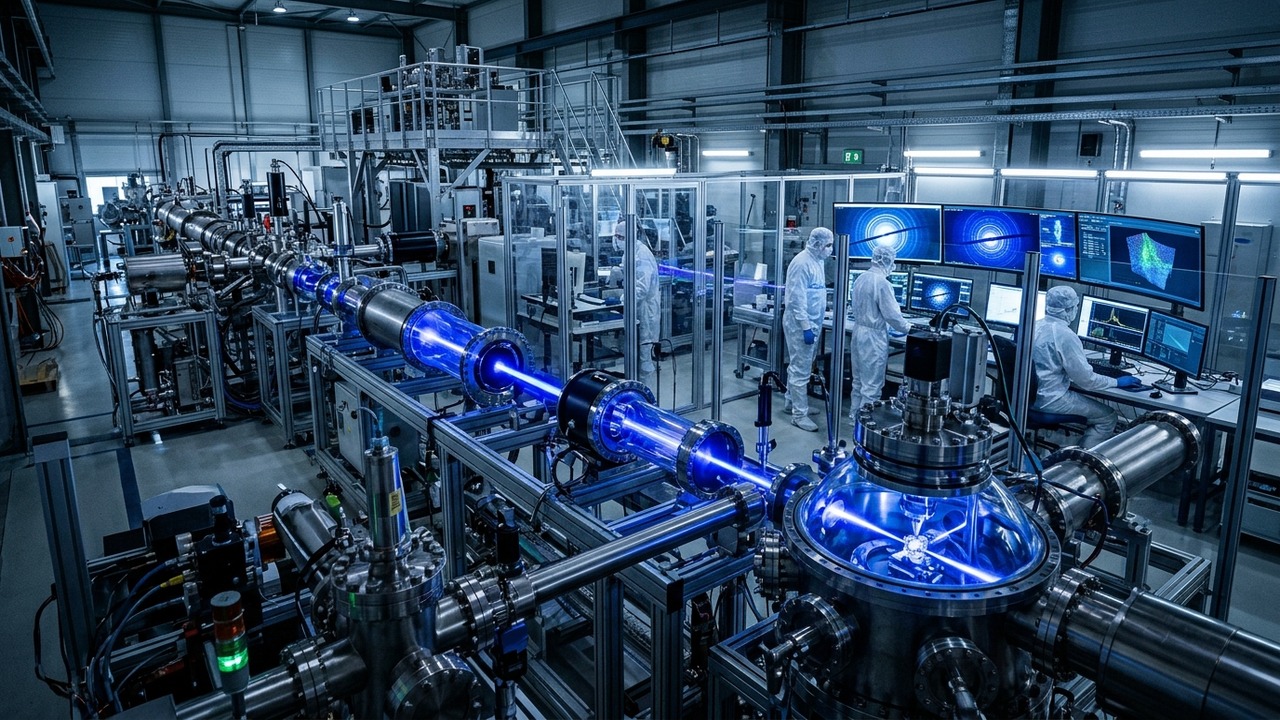
Figure 1: High-energy X-ray Free-Electron Laser (XFEL) beamline focusing coherent sub-angstrom pulses onto crystal targets.
The Sub-Angstrom Frontier: How 2026’s X-Ray Breakthrough Rewrites the Laws of Observation
For decades, the physical sciences have been governed by an invisible barrier: the diffraction limit. To see an object clearly, the wavelength of the light used to observe it must be smaller than the object itself. For the structural biologist, the materials scientist, and the quantum chemist, the "holy grail" has always been the ability to resolve the dance of electrons and the precise geometry of atoms in real-time. In early 2026, that barrier has not just been breached—it has been rendered obsolete.
The recent achievement of an X-ray free-electron laser (XFEL) capable of reliably generating flashes with wavelengths shorter than the distance between atoms represents a seismic shift in our capacity to interrogate matter. By pushing into the sub-angstrom regime with unprecedented stability, researchers are effectively turning the most powerful microscopes in human history into high-speed cameras for the quantum world. This article explores the technical triumph, the geopolitical implications of this infrastructure, and the scientific horizon that now lies open before us.
Quick Facts: The Sub-Angstrom Milestone
- Core Achievement: Consistent generation of X-ray pulses with wavelengths significantly below 0.1 nanometers (1 Angstrom).
- Reliability: Transition from "stochastic" or erratic pulses to high-repetition, stable, and coherent output.
- Primary Application: Real-time "molecular movies" of chemical reactions and protein folding.
- Status: Active operational phase as of Q2 2026.
- Infrastructure: Utilization of superconducting linear accelerators (linacs) to achieve high-energy electron beams.

Figure 2: Sub-angstrom quantum laser diffraction patterns revealing interatomic distances and chemical bonds.
The Physics of the Unseen: Breaking the Diffraction Limit
To capture physical phenomena at the nanoscale, standard optical principles must be completely abandoned. Overcoming the diffraction limit requires light waves smaller than the space between atomic nuclei, demanding an entirely unprecedented mechanism of photon acceleration.
The Anatomy of an X-Ray Flash
To understand the magnitude of this 2026 breakthrough, one must appreciate the sheer violence required to produce these photons. An X-ray free-electron laser operates by accelerating electrons to near-light speeds and forcing them to "slalom" through a series of magnets known as an undulator. As the electrons oscillate, they emit intense, coherent X-rays. Previously, these flashes were often "noisy"—lacking the perfect alignment required for the highest-resolution imaging.
The 2026 advancement centers on the refinement of "self-seeding" techniques and the stabilization of electron beam emittance. By mastering the coherence of the electron bunch before it enters the undulator, engineers have ensured that every pulse is essentially a carbon copy of the last. This reliability is what allows for the reconstruction of three-dimensional molecular structures that were previously blurred by the chaotic nature of earlier laser iterations.
Why Sub-Angstrom Matters
The average distance between atoms in a molecule—the length of a chemical bond—is roughly 1.5 Angstroms. To "see" these bonds, you need light with a wavelength of 1 Angstrom or less. Operating at this threshold allows researchers to move beyond static snapshots. We are no longer limited to the "crystallography" approach, which requires freezing proteins in place. We are now entering the era of "femtosecond structural biology," where we can watch a drug molecule dock into a receptor or a catalyst split a water molecule in the blink of an eye.
Global Context: The Race for Quantum Supremacy
The achievement of sub-angstrom reliability is not merely a laboratory curiosity; it is a centerpiece of 21st-century national industrial policy. As of 2026, the global landscape of X-ray science is dominated by a few key facilities—most notably the European XFEL in Germany, the LCLS-II in the United States, and the SACLA facility in Japan. These installations are the "Big Science" equivalents of the Manhattan Project, involving multi-billion dollar investments and thousands of international researchers.
The strategic stakes are immense. In the current geopolitical climate, the nation that dominates the sub-angstrom regime gains a decisive advantage in three critical sectors:
- Pharmaceuticals: The ability to map the interaction of proteins at the atomic level accelerates drug discovery by years, potentially bypassing traditional multi-year clinical trial screening phases.
- Advanced Materials: Understanding the degradation of battery electrolytes at the femtosecond scale is the key to the next generation of energy storage.
- Semiconductor Design: As transistors reach the atomic limit, observing electron transport in real-time is the only way to design the hardware of the 2030s.
Impact Modeling: From Theory to Reality
Transitioning from predictive mathematical simulations to physical observation has historically been hampered by sensor noise and quantum jitter. With sub-angstrom laser stabilization, researchers can now validate atomic stress models directly in the beamline, bridging decades of computational chemistry with empirical physical truth.
Immediate Fallout: The Data Deluge
The shift to reliable, high-repetition sub-angstrom pulses has created a new bottleneck: data processing. With pulses firing thousands of times per second, the sheer volume of diffraction patterns being generated is orders of magnitude higher than in 2024. This has necessitated a massive pivot toward AI-driven data pipelines. "On-the-fly" machine learning models are now integrated directly into the beamline, performing real-time analysis to decide which pulses contain the most valuable structural information.
Secondary Ripple Effects: The Democratization of Access
While these machines are massive, the 2026 infrastructure model is focused on remote access. Through high-speed quantum-encrypted networks, research teams in universities across the globe can now "pilot" these beamlines from thousands of miles away. This transition is effectively democratizing access to the most powerful tools in physics, moving away from a model where only those on-site can conduct experiments.
Long-Term Implications: The End of "Guesswork" Chemistry
For centuries, chemistry has been a science of inference. We observe the inputs, we observe the outputs, and we infer the mechanism in between. With the ability to reliably image the transition states of chemical reactions—the fleeting, nanosecond-long moments where bonds break and form—we are transitioning to a science of observation. This will fundamentally rewrite textbooks on reaction kinetics and quantum tunneling.
Investigative Synthesis: The Path Forward
The reliable generation of sub-angstrom X-ray pulses is a triumph of engineering, but it is also a starting line. The investigative consensus among lead scientists in the field is that we have transitioned from a phase of "proving it can be done" to a phase of "industrializing the discovery."
However, challenges remain. The intense power of these pulses can destroy biological samples upon contact. Consequently, the focus for the remainder of 2026 and into 2027 is the development of "diffraction-before-destruction" techniques, where the pulse is so fast that it captures the structure of a molecule before the molecule has time to explode from the radiation energy. The reliability we see today is the prerequisite for this high-speed, high-damage, high-reward method of structural analysis.
In conclusion, the 2026 sub-angstrom milestone is more than just a technical record. It is the realization of a long-held human ambition: to peer into the fundamental fabric of reality and witness the mechanics of life and matter in motion. As these facilities continue to refine their output, the pace of innovation in medicine, energy, and computing is set to accelerate at a rate that will define the rest of the decade.
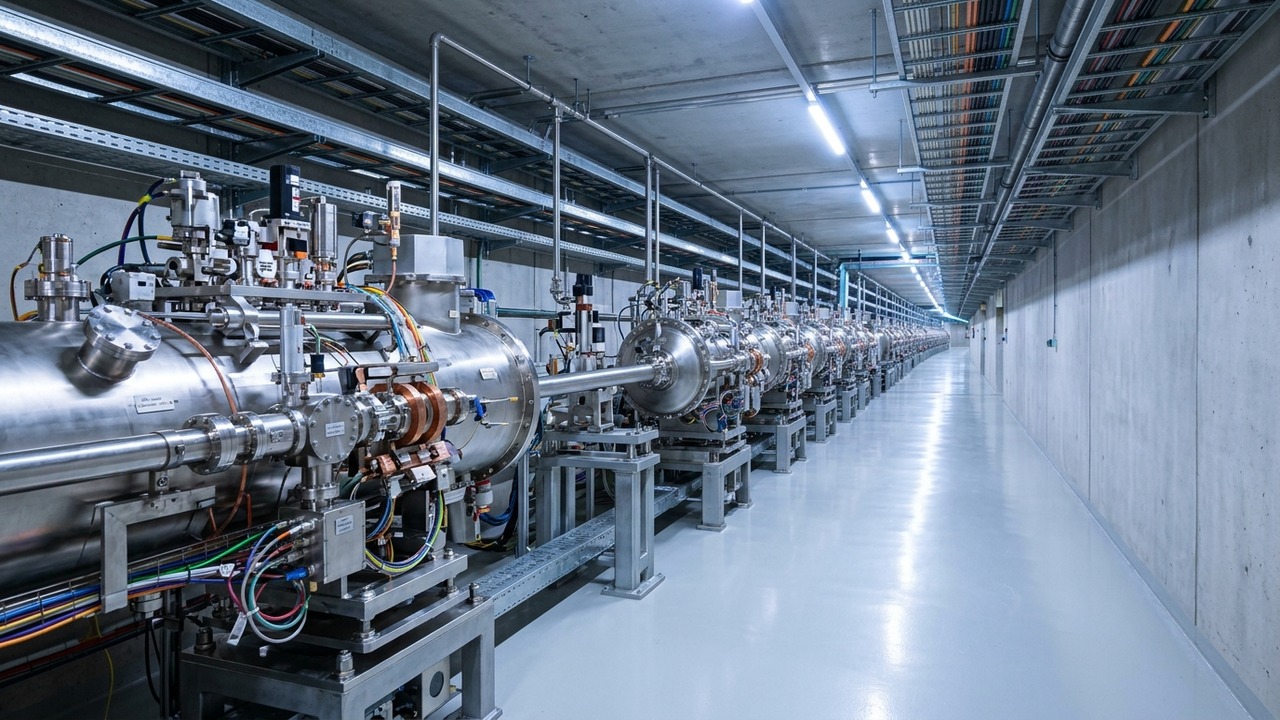
Figure 3: Superconducting linear accelerator vacuum cryomodules driving ultra-short coherent X-ray pulses.
To leave a comment, click the button below to sign in with Blogger.